
Planning a wedding can feel overwhelming.
There are dozens of decisions. Hundreds of options. And no clear starting point.
Every website tells you something different. Every supplier has a different recommendation. And before you've even booked anything, you're already second-guessing yourself.
So here's the simplest way to think about it.
Wedding planning isn't one big task. It's a sequence of smaller decisions — made in the right order. Get the order right, and everything else follows. Get it wrong, and you'll find yourself committed to a venue you can't afford, a guest list that's too big, and suppliers who are already booked.
This guide walks you through every step — in the right order.
The UK Wedding Planning Timeline at a Glance
Before diving in, here's how most couples structure their planning across 12–18 months:
|
12–18 months out |
Budget, venue shortlist, guest list draft |
|---|---|
|
9–12 months out |
Venue booked, key suppliers confirmed |
|
6–9 months out |
Invitations, catering, floristry, cake |
|
3–6 months out |
Dress fittings, transport, accommodation, order of day |
|
1–3 months out |
Final confirmations, seating plan, payments |
|
Final weeks |
Supplier briefings, timeline finalised, emergency kit packed |
The earlier you start, the more choice you have — especially for venues and photographers, which book up fastest.
Step 1: Set Your Budget
Everything starts here. Without a budget, nothing else makes sense.
The average UK wedding in 2026 costs between £20,000 and £22,000. But that number means very little on its own. What matters is how you split it across categories — and whether that split matches your priorities.
Before you look at a single venue or supplier, you need to know three things:
Your total number. What can you realistically spend? Include any family contributions, savings, and how much you're willing to put on credit. Be honest. A budget that looks good on paper but requires borrowing you can't manage is not a real budget.
Your non-negotiables. What matters most to you? Photography? The venue? The food? Most couples have one or two things they genuinely care about and several they don't. Knowing this upfront means you can overspend in the right places and cut elsewhere without regret.
Your contingency. Build in 15% on top of your planned spend. Not 10% — 15%. The average UK couple overspends by £4,200, and it almost always comes from costs they weren't told about upfront: VAT excluded from quotes, mandatory service charges, cake-cutting fees, overtime. A 15% buffer absorbs most of it.
A rough starting point for how your budget typically breaks down:
|
Venue |
25–30% |
|---|---|
|
Catering |
20–25% |
|
Photography & video |
10–12% |
|
Dress & attire |
8–10% |
|
Flowers |
5–8% |
|
Entertainment |
5–8% |
|
Cake |
2–3% |
|
Stationery |
1–2% |
|
Transport |
2–3% |
|
Insurance |
<1% |
|
Everything else |
Remaining buffer |
Everything else — remaining buffer
These percentages shift based on your priorities. If photography is your non-negotiable, push it to 15% and trim elsewhere. The point is to have a plan before you start spending — not to reverse-engineer a budget after the fact.
👉 Start your wedding plan now (free)
Get your full budget breakdown instantly with Wedvisa.
Step 2: Choose Your Venue
Your venue is the single most important decision you'll make. It defines almost everything else — your guest count, your style, your supplier options, and a large chunk of your total cost.
Book it early. The best UK venues book up 12–18 months in advance, especially for Saturday slots in peak season (April through September). If you have a specific date in mind, your venue shortlist is the first call to make.
What Your Venue Choice Actually Determines
1. Guest capacity: Every venue has a maximum. If your dream venue holds 80 and your list has 120 names on it, something has to give — and it's usually the guest list, not the venue.
2. Location: Where you marry has a bigger impact on cost than most couples realise. A London wedding averages £27,000. The same celebration in the North West averages £17,300. That's nearly £10,000 difference for an identical wedding.
3. Style: A barn dictates one aesthetic. A city venue another. A stately home another entirely. Your venue sets the creative brief for everything — flowers, stationery, dress, table settings — whether you intend it to or not.
4. Supplier flexibility: Some venues operate on a dry hire basis — you bring in your own caterers, furniture, even toilets in some cases. Others mandate in-house catering and a preferred supplier list. Neither is wrong, but they have very different cost and flexibility implications.
Venue Types and Their Average Hire Costs in 2026
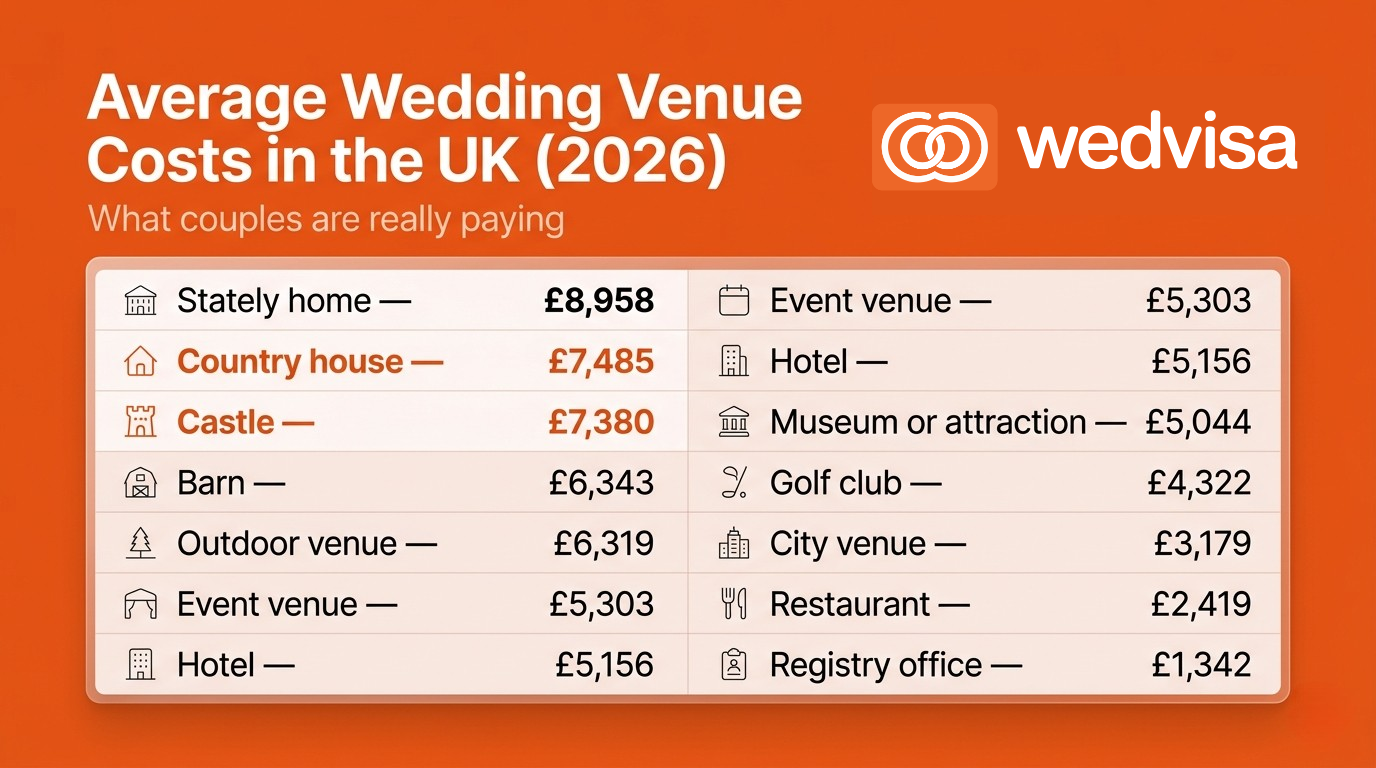
Questions to Ask Every Venue Before You Visit
Do these prices include VAT?
Is there a mandatory service charge?
What's included in the hire fee and what's extra?
Do you have a preferred or exclusive supplier list?
What's the difference in price between a Saturday in peak season and a midweek date in January?
That last question is worth asking every single time. The gap between a Saturday in June and a Tuesday in January at the same venue can be £6,000 or more.
💡 Pro tip: If your guest list is flexible, commit to a venue before you finalise the numbers. Your venue will set your maximum — and working within a clear capacity is far easier than trying to trim a list after people already know they're invited.
Step 3: Build Your Guest List
Your guest list is the second most powerful lever in your budget — and the one most couples underestimate.
Here's the counterintuitive truth: the cost per head actually decreases as your guest list grows. That's because your fixed costs — venue hire, photography, flowers, entertainment — stay roughly the same whether you have 50 or 150 guests. More guests means you're spreading those fixed costs across more people.
What UK Weddings Cost by Guest Count
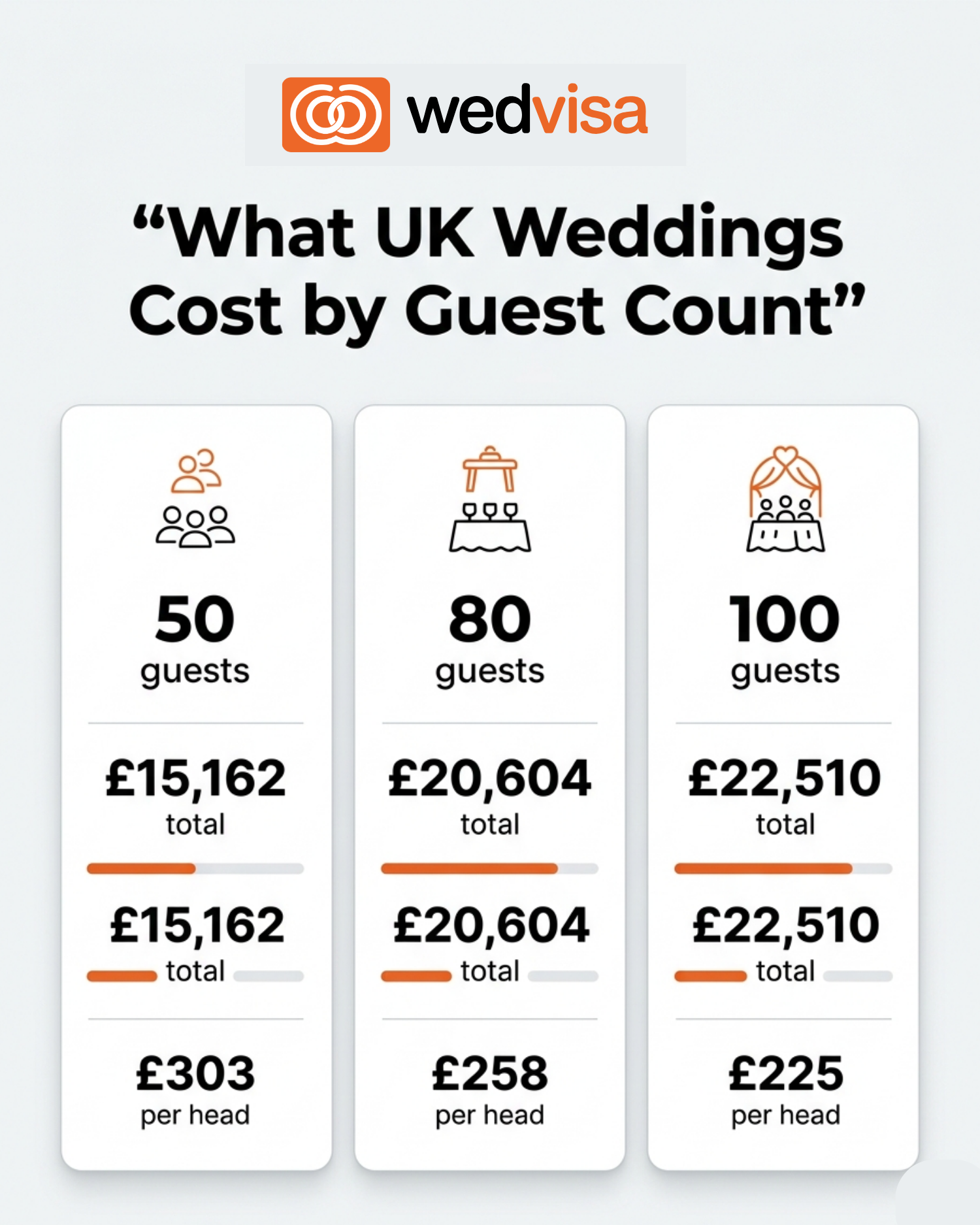
What this means in practice: cutting your guest list from 100 to 50 saves around £7,000 — but most of that saving comes from catering and seating, not from the fixed costs. Your photographer, venue, DJ, and florist cost broadly the same either way.
So before you start cutting names, know which categories your guest count actually affects — and which ones it doesn't.
The A/B/C List Approach
Most wedding planners recommend building your list in tiers. Your A list is everyone you'd genuinely be upset not to have there. Your B list is close friends and family who matter but aren't essential. Your C list is everyone else — colleagues, distant relatives, plus-ones you haven't met.
Start with A only. See what that does to your capacity and catering costs. Add B selectively. C is your reserve list if you get declines.
Day Guests vs Evening Guests:
Splitting your celebration into a day reception and an evening do is one of the most effective ways to manage headcount and cost. Day catering (a full sit-down meal) costs significantly more per head than evening food (a buffet, street food, or late-night snacks). Inviting 60 people to the day and 120 to the evening is often far cheaper than feeding all 120 a plated dinner.
💡 Pro tip: Finalise your venue before you finalise your guest list. Knowing your capacity ceiling makes the list conversation much easier — and gives you a built-in reason to keep numbers manageable.
Step 4: Book Your Key Suppliers
Once your venue is confirmed and your guest list is roughly set, your next job is locking in your key suppliers. Do this before anything else — the best photographers, caterers, and bands get booked up fast, and losing your first-choice suppliers to poor timing is one of the most common and avoidable planning regrets.
The order matters. Book in this sequence:
1. Photographer (and Videographer)
Photography is the one thing you'll have forever. It's also the supplier category most commonly underprioritised in early budgeting and most regretted after the day. Book early — 12 months out minimum for popular photographers, especially in London and the South East.
Average UK cost in 2026:
|
Full-day photography |
£1,200–£2,500 |
|---|---|
|
Videography |
£1,200–£2,200 |
|
London & South East |
often £2,000–£4,000+ |
What to look for: a portfolio that matches your venue style, a shooting approach that fits your personality (documentary vs posed), and someone you'd genuinely be comfortable having follow you around for 10 hours.
2. Catering
If your venue doesn't mandate in-house catering, this is your biggest variable cost and your biggest opportunity to control spend.
Average costs per head by service style:
|
Plated dinner (3-course) |
£100–£200 |
|---|---|
|
Hot buffet |
£20–£50 |
|
Cold buffet |
£15–£20 |
|
Street food/food trucks |
£10–£20 |
|
Evening food (grill, pizza, buffet) |
around £30 |
One important note for 2026: alcohol duty rates rose in February, which is feeding through to higher per-bottle wine costs and open-bar estimates. Factor this in when comparing catering quotes from different suppliers.
3. Entertainment
Your entertainment sets the tone of the reception. Whether that's a live band, a DJ, a string quartet for the ceremony, or a combination — book early and be clear about timings, setup requirements, and what's included in the fee.
Average UK costs:
|
Live band (4-piece)Live band (4-piece) |
£1,500–£3,500 |
|---|---|
|
DJ |
£500–£1,500 |
|
String quartet (ceremony) |
£600–£1,200 |
4. Floristry, cake, stationery, transport
These can come slightly later — 6 to 9 months out — but don't leave them to the last minute. Florists and cake makers in particular have limited capacity on peak dates.
Questions to Ask Every Supplier
Is the quoted price inclusive of VAT?
What's your payment schedule?
What happens if you're ill or unavailable on the day?
Do you have public liability insurance?
Have you worked at our venue before?
That last question matters more than most couples realise. A photographer who knows your venue's lighting and a caterer who knows the kitchen layout will deliver a better result than one who's working there for the first time.
💡 Pro tip: Get every agreement in writing — including what happens if a supplier cancels. Verbal agreements aren't worth anything when something goes wrong.
Step 5: The Details (Months 3–9)
With the big decisions made, this phase is about filling in everything else — without letting the detail spiral into stress.
Invitations and Stationery
Send save-the-dates as soon as your venue and date are confirmed — ideally 9 to 12 months out for a peak-season wedding, 6 months for midweek or off-peak. Formal invitations typically go out 8 to 12 weeks before the day.
Average stationery costs:
|
Save-the-dates |
£100–£300 |
|---|---|
|
Invitations (full suite) |
£200–£500 |
|
On-the-day stationery (menus, orders of service, table plans) |
£100–£400 |
Dress and Attire
Allow more time than you think for the dress. From first appointment to final fitting, the process often takes 6 to 9 months for a made-to-order gown. Alterations alone — which are almost always needed — cost £200 to £800 and require 2 to 3 fittings.
Average costs:
Wedding dress — £1,000–£3,000 (mid-range), £500–£800 (budget), £2,500–£8,000+ (premium)
Menswear (hire or purchase) — £200–£859
Transport
Often forgotten until late in the planning process, and then rushed. The average cost is £300 to £800 for a car or a small fleet. If you're getting married in a remote venue, also think about guest transport — minibuses between the venue and accommodation are increasingly expected and save guests the designated driver problem.
Accommodation
Block-book a local hotel room allocation for out-of-town guests as early as possible — especially for August weddings when rooms fill quickly. If you're getting married in Edinburgh during festival season, this is essential.
Wedding insurance
Frequently overlooked until it's too late. A standard UK wedding insurance policy costs £98 to £180 and covers cancellation, supplier failure, and in some cases extreme weather. For a £20,000+ event, it's one of the most cost-effective decisions you can make.
Step 6: Track Everything
This is where most couples fall apart — not because they make bad decisions, but because they lose track of what they've committed to.
By the time you're 6 months into planning, you'll have:
1. Multiple supplier contracts at different payment stages
2. A guest list with RSVPs in various states
3. Dietary requirements, plus-ones, and table preferences coming in from different directions
4. A budget that's evolved since you first set it
5. A timeline for the day that nobody has fully agreed on yet
Without a single place to track all of this, things get missed. Payments go out at the wrong time. Suppliers don't receive their final briefing. The seating plan is built on outdated information.
What good tracking looks like:
A budget tracker that shows what you've committed to, what you've paid, and what's still outstanding — not just a rough total.
A supplier contact sheet with names, numbers, contracts, and payment schedules in one place.
A guest list tracker with RSVP status, dietary needs, table allocation, and whether they're day or evening guests.
A day-of timeline that's been shared with and approved by every key supplier — venue coordinator, photographer, caterer, and entertainment.
The couples who stay on budget and arrive at their wedding day feeling calm aren't the ones who planned more carefully from the start. They're the ones who tracked more consistently throughout.
👉 Plan your entire wedding in minutes — free on Wedvisa
Your budget, your suppliers, your guest list — all in one place.
Frequently Asked Questions
How far in advance should you start planning a UK wedding?
12 to 18 months is the standard recommendation for a Saturday wedding in peak season. If you're flexible on date and day of the week, 9 to 12 months is workable. Micro-weddings and registry office ceremonies can often be planned in 3 to 6 months.
What's the first thing to book when planning a wedding?
Your venue. Everything else — your date, your guest count, your supplier options — flows from that one decision. The earlier you secure the venue, the more flexibility you have on everything else.
How do you stick to a wedding budget?
Three things: set it before you start looking at anything, break it down by category so you know what each area is allowed to cost, and track it throughout rather than doing a total at the end. A 15% contingency buffer is non-negotiable.
Is it cheaper to get married on a weekday?
Significantly. A midweek wedding can save 30 to 50% on venue hire alone. The average Saturday wedding costs £22,290. The average Tuesday wedding costs £16,273. That's a saving of £6,000 on a single scheduling decision.
What do most couples forget to budget for?
VAT (often excluded from venue and caterer quotes), mandatory service charges (15–25% on catering), cake-cutting fees, supplier meals, overtime charges, dress alterations, and wedding insurance. These alone can add £3,000 to £5,000 to a budget that looks balanced on paper.
How many guests should you invite?
The honest answer is: as many as your venue can hold and your budget can absorb. The UK average in 2026 is 74 day guests and 21 evening guests. But more importantly — know how each additional guest affects your catering cost before you extend any invitations.