
Just got engaged?
Amazing. Genuinely — congratulations.
Now comes the part nobody prepares you for.
You've said yes, you've called the people who matter, you've posted the photo. And then somewhere in the middle of all the excitement, someone asks, "So, have you thought about a venue?"
And just like that, the overwhelm begins.
The internet doesn't help. Search "what to do after getting engaged" and you're immediately buried in 47-step checklists, conflicting timelines, and advice that assumes you have a wedding planner on speed dial and a Pinterest board you've been curating since 2019.
Here's the truth: you don't need to do everything at once. You don't need to have answers to questions you haven't even thought to ask yet. You just need to get the first five steps right — in the right order.
Everything else follows from those.
Step 1: Set a Rough Budget
Before anything else. Before venues. Before guest lists. Before you open a single wedding website.
This is the step most couples skip — or rush through — because it's less exciting than browsing stately homes and it requires an honest conversation about money. But skipping it is exactly what leads to booking a venue you can't afford, building a guest list that blows your catering budget, and arriving at your wedding day with debt you didn't plan for.
You don't need a precise number at this stage. You need a realistic one.
Start with 3 Questions
What do we actually have available?
This means real savings, not hypothetical ones. Be honest about what you're genuinely willing to spend and what you're comfortable putting on credit.
Is any family contributing?
If parents or relatives have offered to help, have that conversation now — early and directly. Family contributions are wonderful, but they come with expectations that are much easier to navigate before any decisions are made than after. Find out what the number is, whether there are any strings attached, and whether it's a gift or a loan.
What are our non-negotiables?
Every couple has one or two things they genuinely care about — the venue, the food, the photographer, the band. Knowing your priorities upfront means you can spend generously in the right places and cut without regret everywhere else.
A rough starting point for how UK wedding budgets typically break down:
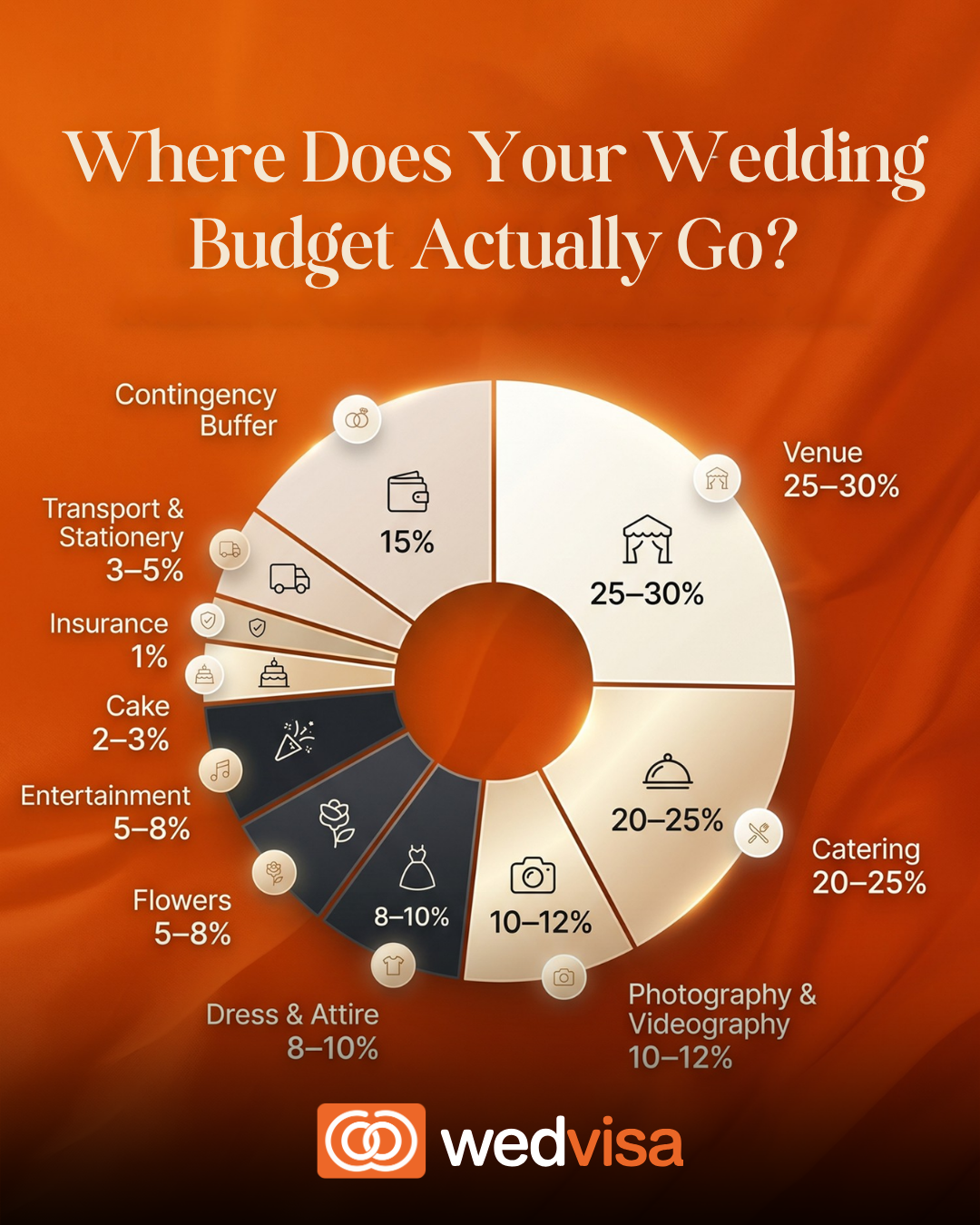
That last line isn't optional. The average UK couple overspends by £4,200 — almost always on costs they weren't told about upfront: VAT excluded from quotes, mandatory service charges on catering, cake-cutting fees, overtime charges. A 15% buffer absorbs most of it. Build it in before you start, not after you've already overspent.
💡 Pro tip: At this stage your budget doesn't need to be perfect. It needs to be honest. A rough number that reflects reality is infinitely more useful than an optimistic figure that makes you feel better for three months and then causes stress for the remaining nine.
Step 2: Decide on a Rough Guest Count
Your guest count and your budget are the two numbers that control everything else. Get them both established early, and the rest of your planning becomes significantly easier.
Here's why guest count matters so much: it determines your venue size, your catering cost, your stationery spend, your furniture requirements, and in many cases whether certain venues are even physically possible for you. Falling in love with an intimate 60-person barn while carrying a 130-person guest list is a mismatch that no amount of creative thinking will fix.
The honest numbers:
The average UK wedding in 2026 has around 74 day guests and 21 evening guests. But averages don't tell you much. What matters is how your specific headcount interacts with your specific budget.
Here's the counterintuitive part: the cost per head actually goes down as your guest list grows, because your fixed costs — venue hire, photography, entertainment, flowers — stay roughly the same whether you have 50 or 150 people. More guests means more people sharing the fixed costs.
In practice:
50 guests — around £15,162 total (£303 per head)
80 guests — around £20,604 total (£258 per head)
100 guests — around £22,510 total (£225 per head)
This means cutting your guest list from 100 to 50 saves around £7,000 — but most of that saving comes from catering and seating, not from the photographer, the band, or the flowers. Know which categories your headcount actually affects before you start making cuts.
A simple approach:
Start with your A list only — everyone you would genuinely be devastated not to have at your wedding. Count them. See what that number does to your venue requirements and catering estimate. Then decide whether to expand from there, and by how much.
Don't invite anyone to your wedding before you've set your budget and shortlisted your venue. Once someone knows they're invited, uninviting them is painful and awkward. Keep your options open for as long as possible.
💡 Pro tip: Consider splitting your day. A smaller sit-down reception (day guests only) followed by a larger evening celebration is one of the most effective ways to manage both headcount and cost — evening food costs significantly less per head than a formal plated dinner, and it lets you include more people without proportionally increasing your catering bill.
Step 3: Choose Your Location
Not your venue. Your location — the area, the region, the general part of the country where you want to get married.
This distinction matters because location has a bigger impact on your total spend than most couples realise, and deciding it early protects you from a common and expensive mistake: falling in love with a venue in a region whose supplier rates are 30% above your budget's assumptions.
The regional reality:
UK wedding costs vary significantly by geography. A wedding in London averages around £27,000. The same celebration in the North West of England averages around £17,300. That's nearly £10,000 difference — not because one wedding is better than the other, but purely because of postcode.
And it's not just the venue. When you marry in a specific region, you're also drawing from that region's pool of photographers, caterers, florists, and entertainment. Couples who travel from one part of the country to marry in another — from Manchester to the Cotswolds, say — frequently underestimate the 20–30% supplier price differential in their destination region. The venue hire looks manageable. It's the local suppliers that quietly close the gap.
Questions to help choose your location:
Where do we actually want to be on our wedding day?
For some couples, this is an easy answer — a hometown, a place that means something, a city you've always loved. For others it's genuinely open.
Where are most of our guests coming from?
A venue that's convenient for the majority of your guests reduces accommodation costs, travel stress, and the chance of people not making it. A remote destination venue is beautiful in theory; in practice it means asking people to take time off work and pay for hotels.
Are we open to off-peak regions?
If your priority is a beautiful setting at a lower cost, regions like the North East, North West, and parts of Wales consistently offer better value than London and the South East without sacrificing quality.
What style of wedding are we imagining? A rural Scottish estate, a London townhouse, a Cotswolds barn, and a coastal Cornwall venue all suggest very different aesthetics, price brackets, and logistics. Aligning your location with your vision early saves you from pursuing venues that were never going to be right.
💡 Pro tip: Don't limit your location search to where you currently live. Venue hire costs vary by up to £10,000 between regions — and a midweek wedding in an off-peak region can save you more than a year's worth of savings contributions.
👉 Start Your Wedding Plan Properly
Use the free Wedvisa planner — build your plan, see your full budget breakdown, and stay organised from day one.
✔ Build your plan
✔ See your budget
✔ Stay organised
Step 4: Research Venues
Now — and only now — are you ready to start looking at venues. You have a budget. You have a rough guest count. You have a location. You know what you can afford and roughly how many people you're planning for. This is the only basis on which venue research is genuinely useful.
Venues are the most time-sensitive booking in the entire planning process. The best ones in any region book up 12–18 months in advance, particularly for Saturdays in peak season (April through September). Starting your venue search early, with a clear brief, is one of the highest-leverage decisions you can make in the first weeks after getting engaged.
What your venue choice actually determines:
Beyond the obvious — location, capacity, style — your venue shapes decisions you haven't even started thinking about yet. It sets your supplier options (some venues mandate in-house catering or a preferred supplier list). It defines your aesthetic (a barn, a hotel ballroom, and a stately home each pull your decor in completely different directions). It affects your guest logistics (remote rural venues require more active planning around accommodation and transport). And it establishes your maximum capacity ceiling, which in turn finalises your guest list.
Venue types and their average hire costs in 2026:
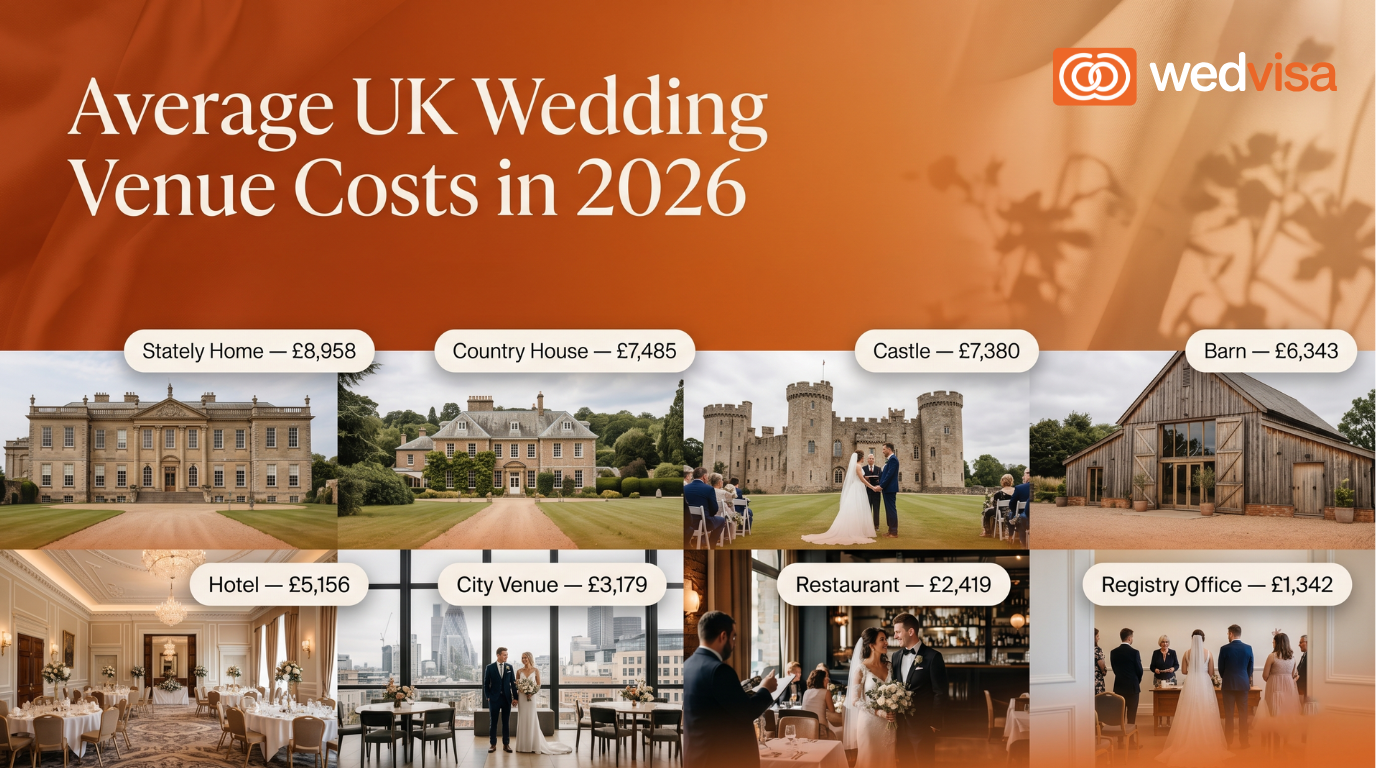
The dry hire question:
Many couples are drawn to barn venues, warehouses, and blank-canvas spaces because the initial hire fee looks lower. Be careful here. A dry hire venue means you're responsible for sourcing every element independently — caterers, furniture, crockery, staffing, sometimes even power and toilets. What looks cheaper upfront often costs more in total once you've added the infrastructure. Always get a full cost estimate, not just the hire fee, before you compare venues.
Questions to ask every venue before you visit:
Does the quoted price include VAT?
Is there a minimum spend requirement?
Do you have an exclusive or preferred supplier list — and do you charge an external vendor fee if we bring our own photographer or caterer?
What's the difference in price between a Saturday in June and a midweek date in January?
What's included in the hire fee and what's charged separately?
That last question — about the cheapest available date — is one most couples never think to ask. The gap between peak Saturday pricing and off-peak midweek pricing at the same venue can be £4,000 to £6,000. Always ask.
💡 Pro tip: Visit at least three venues before making any decision. It's easy to fall in love with the first beautiful place you see. Seeing three gives you context — a basis for comparison, a sense of what your budget actually buys across different venue types, and the negotiating confidence that comes from not being emotionally committed to a single option.
Step 5: Create a Planning Timeline
Once your venue is booked and your date is confirmed, you have a deadline — and with a deadline, you can build a real plan.
Most couples underestimate how long wedding planning actually takes. Not in terms of hours per week, but in terms of lead times. Photographers get booked out a year in advance. Made-to-order wedding dresses take six to nine months from first appointment to final fitting. Florists and cake makers have limited capacity on peak dates. Getting organised early isn't about being Type A — it's about having access to your first choice in every category rather than whoever happens to still be available.
A realistic UK wedding planning timeline:
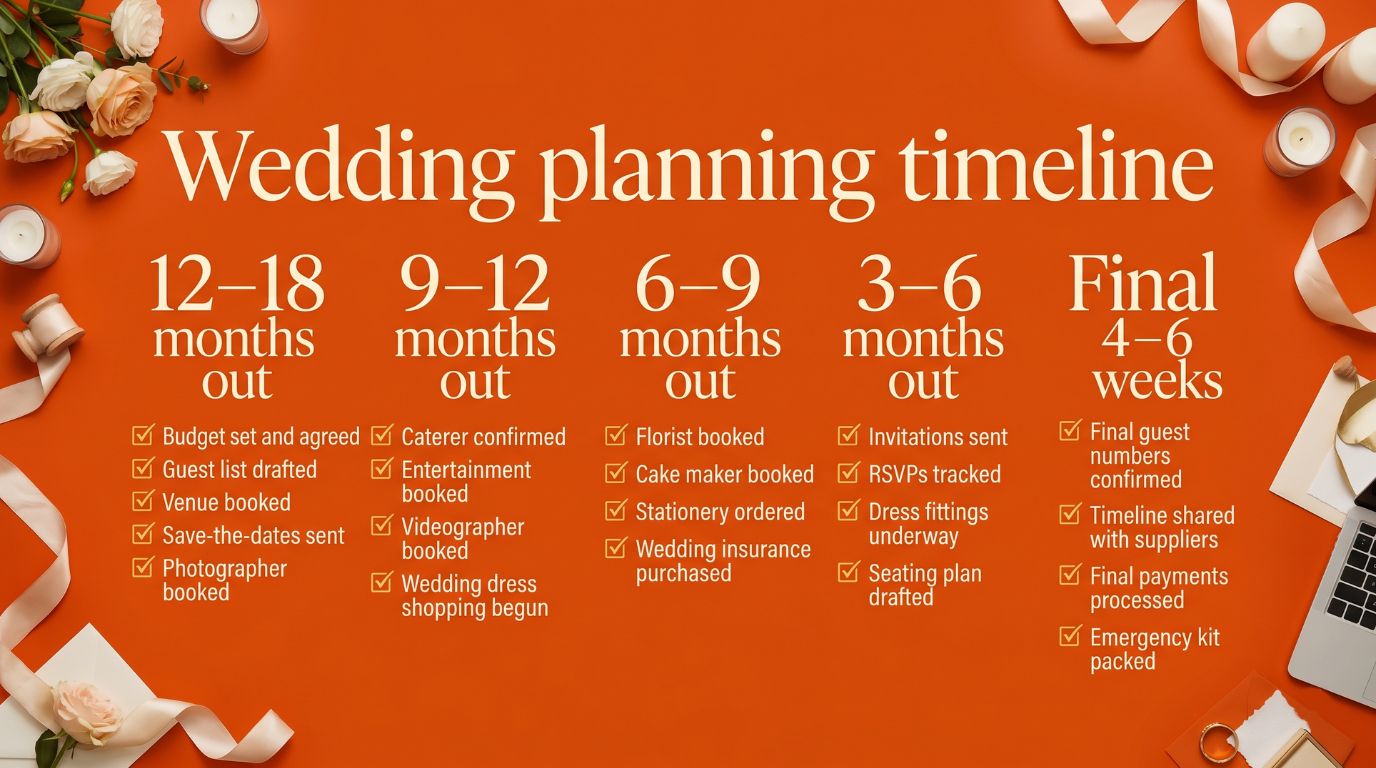
A note on flexibility:
This timeline assumes a 12–18 month engagement and a peak-season Saturday wedding. If you're planning a midweek wedding, an off-peak date, or a smaller celebration, many of these lead times compress significantly. A micro-wedding or registry office celebration can often be planned in three to six months without losing access to quality suppliers. Adjust the timeline to your actual date, not to a generic template.
💡 Pro tip: Add every supplier payment to your calendar the moment you sign a contract. Late payments can void contract terms and create disputes at exactly the point in planning when you have the least time to deal with them. Set a reminder two weeks before every due date so nothing catches you off guard.
The Simplest Way to Think About It
Five steps. In this order:
1. Budget
2. Guest count
3. Location
4. Venue
5. Timeline
Every couple that goes into wedding planning feeling overwhelmed is usually missing one of the first three. They've started browsing venues before they know what they can spend. They've invited people before they know their capacity. They've fallen in love with a location before they've checked whether its supplier rates fit their budget.
Get the foundations right first, and the rest of wedding planning becomes a sequence of decisions — each one informed by the ones before it — rather than a chaotic pile of things happening all at once.
👉 Turn your engagement into a real plan — start free on Wedvisa
Your budget, your guest list, your timeline — all in one place.